

Monosus's tagline , "We Co-Build," is followed by eight words: Relationship, Team, Community, Narrative, Brand, Eco System, Business, Today and Tomorrow. In the second installment of this series in which the CEO himself speaks about "We Co-Build," we interviewed him on the theme of "We Co-Build Relationship."
In this series about Sugimoto's "We Co-Build," we'd like to start by asking about "what" we'll be creating together. First, let's look at the top item: "Relationship - A relationship where we listen to different perspectives and small voices."
If you look at Manabe Monosus from the perspective of, for example, economic rationality, I think it's a rather weak organization. But I think that in reality, the connections are strong. That's where the concept of "a relationship that listens to different perspectives and small voices" comes from. As I mentioned last time, I myself want to do business that is "people-centered" and "passion-centered" rather than just about profitability.
Sugimoto: That also means you place a lot of importance on relationships, right?
Manabe: This might be a bit of a digression, but I always keep points 2 and 3 of the " creation policy " that I wrote when launching Food Hub in mind when I work at Monosus. For example, when we were creating a new bakery in our food business, we focused not on "making a bakery that sells well," but on "whether we could build good relationships with the community and customers and continue doing so."
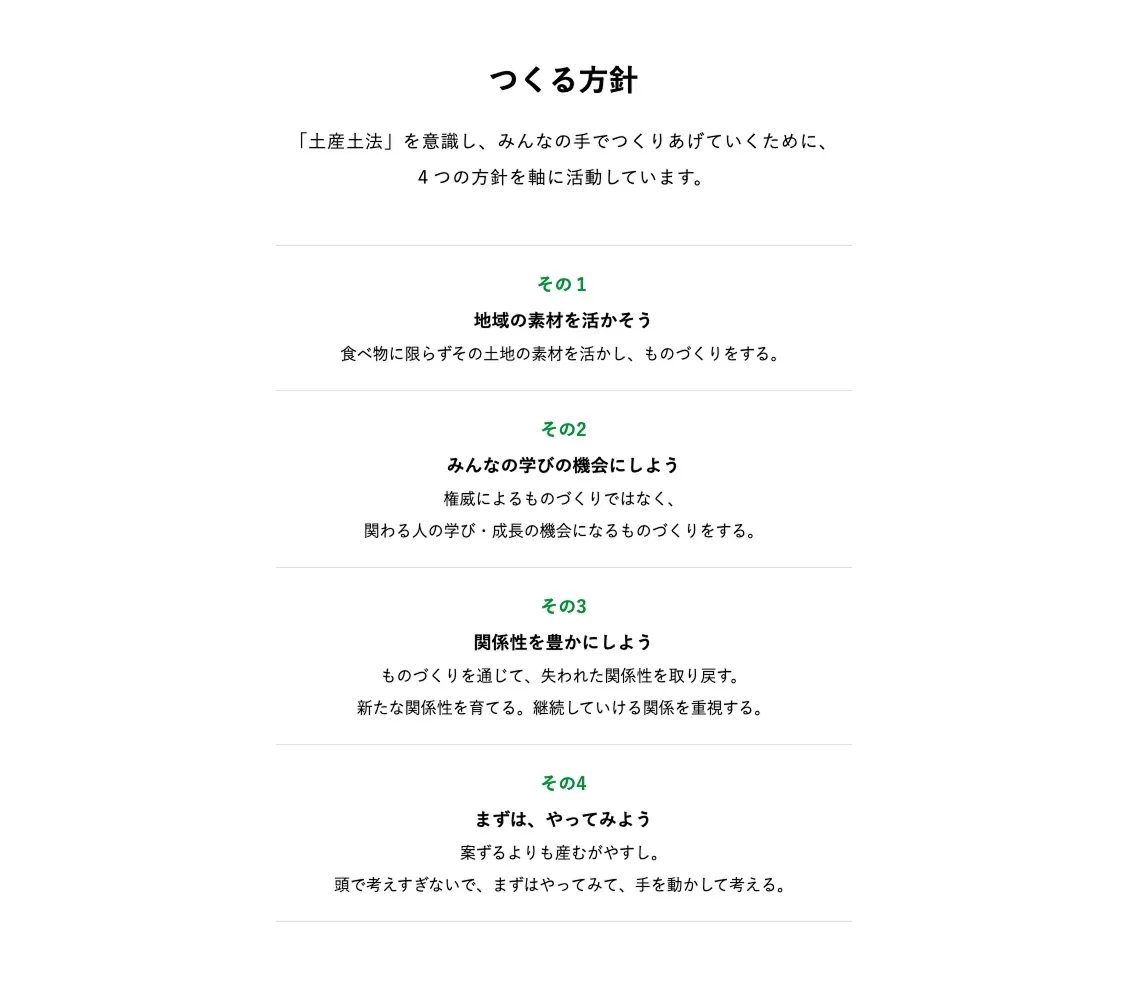
"Part 2: Let's make it a learning opportunity for everyone | Instead of manufacturing based on authority, let's create products that provide learning and growth opportunities for those involved."
"Point 3: Enrich relationships | Through manufacturing, we will recover lost relationships, cultivate new ones, and prioritize relationships that can be sustained."
Sugimoto's view is that economic rationality is merely one element that contributes to the continuation of that relationship.
Manabe: That's right. In web and other businesses, I think that projects that last a long time are ultimately those that maintain a really good relationship with the client. The team members talk about "what kind of person" the client is. They say things like, "This person's way of working is amazing," or "This person is interesting in this way," and they say a lot of positive things about the person. I feel like that's why the work goes well. That might be why we put "Relationship" at the top of "We Co-Build."
Sugimoto: After Relationship, it continues with Team, Community, and Narrative. I wondered if there was a story behind this order.
Are you familiar with Daniel Kim Manabe's "Success Cycle Model"? It's a virtuous cycle in which improving the "quality of relationships" leads to more active communication, which in turn improves the "quality of thinking," and this improved thinking leads to improved "quality of action," ultimately resulting in higher "quality of results." Our former CEO, Mr. Hayashi, used to often say, "The quality of relationships is important," and I agree.
Whether it's teamwork within the company or projects with clients, I think it all comes down to whether or not you have a solid relationship. That's probably why I put "Relationship" first. In my case, I think I decide whether or not to work with a client or partner based on whether or not I can build a good relationship with them.
Another important aspect here is a sense of purpose. Without a common goal for working together as an organization, prioritizing "relationships" can lead to complacency. In order to have tough discussions when necessary, it's crucial that everyone understands the purpose of "why we are working together."
While listening to Ms. Manabe's story, I was reminded of Joseph Schumpeter's "Capitalism, Socialism, and Democracy," which I read in connection with another project. To put it very simply, the argument is that the "cultural foundation" of capitalism is irrational, and that when economic rationalism permeates society and destroys (economically irrational) relationships and culture, capitalism will decline as a result. Perhaps Monosus's emphasis on relationships, culture, and other "economically irrational" things may, perhaps unintentionally, also contribute to increasing the sustainability of a profit-making organization like a company.
Next, we'll be hearing about "We Co-Build Teams." Stay tuned!

SUGIMOTO Kyoko
Freelance writer. Since autumn 2016, she has been serializing ``Kamiyama no Musumetachi'' in Hinagata, in which she interviews women who have moved to Kamiyama.