
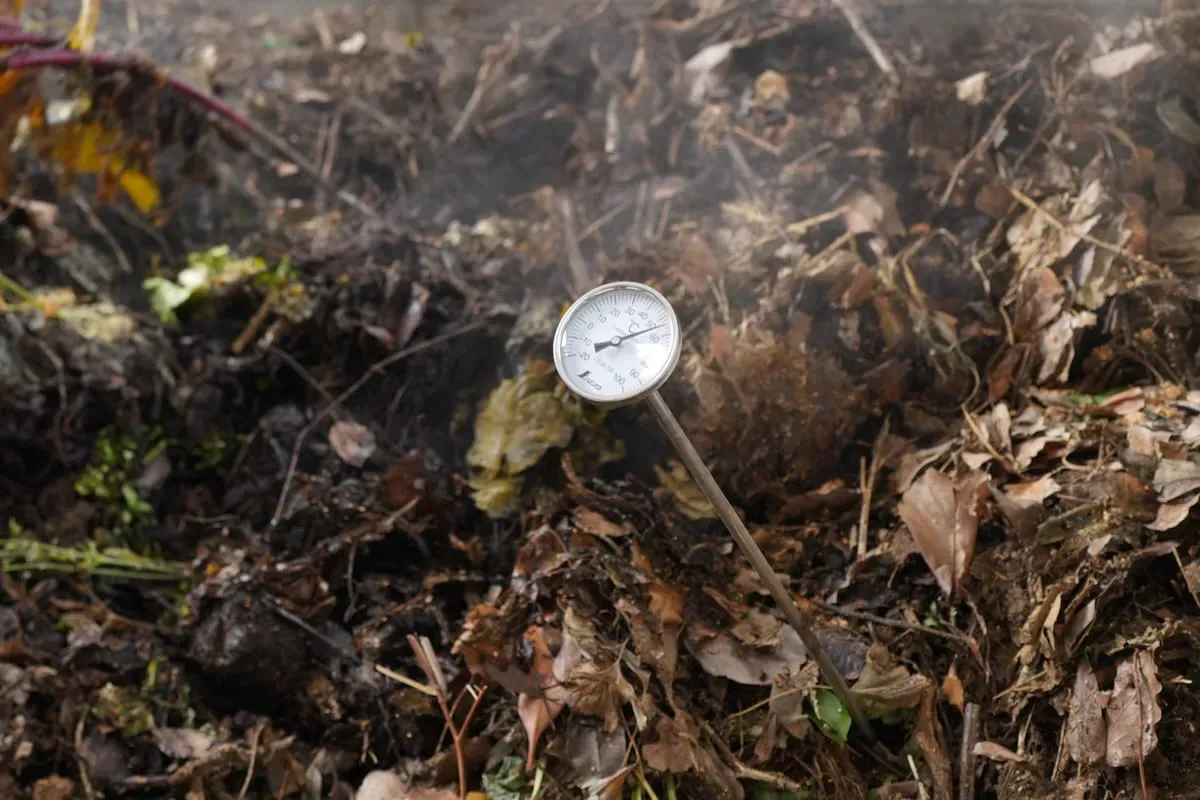
WEATHER: CLOUDY
HUMIDITY: 31%
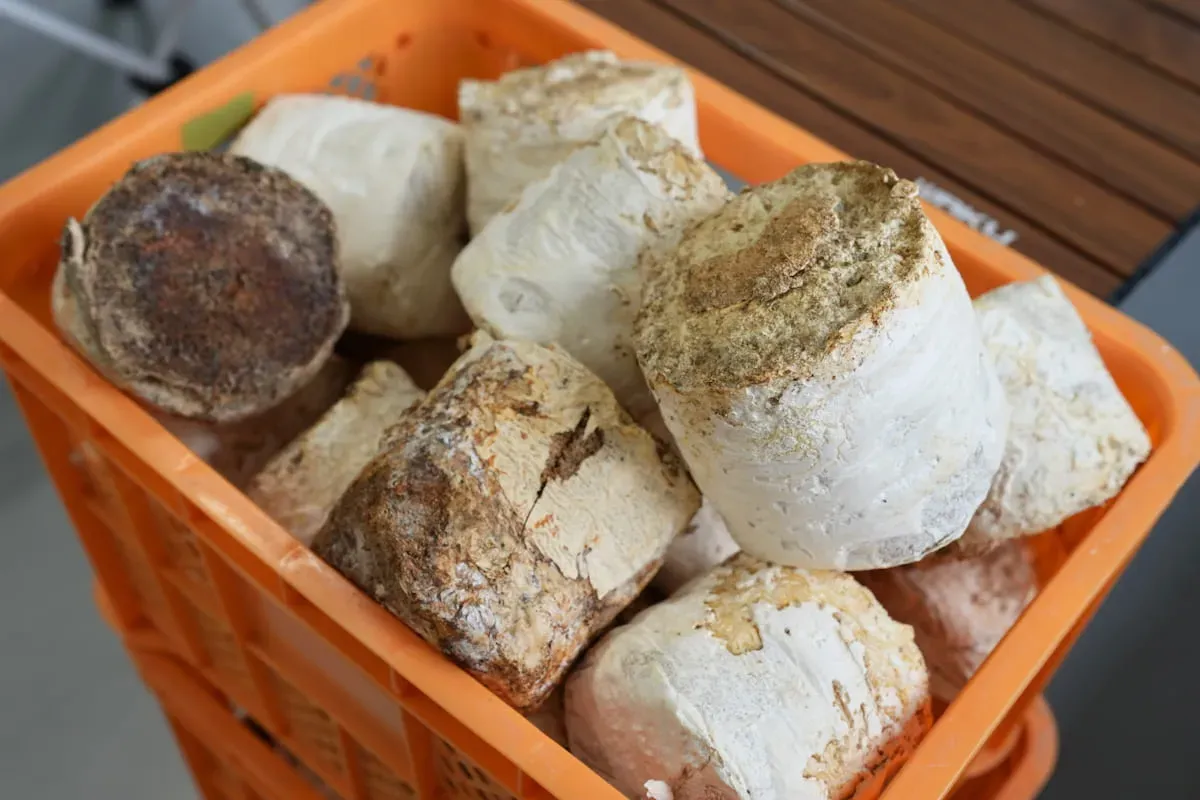
The spent mushroom growing medium, or "spent mushroom substrate," can be used as a soil conditioner in fields.
At KINOKO SOCIAL CLUB, we entrusted the produce to the Sunamachi Community Farm in Koto Ward, where it was composted and used to create vegetable gardens for the community.
This time, I visited Sunamachi Community Farm and spoke with the director, Mr. Hayashi.
We're broadcasting the process on our podcast, "IKINOKO RADIO."
Spotify
Apple
Talk members:
Yasuhiro Hayashi (Director of Sunamachi Community Farm, Tenryu Landscape Construction )
Mayu ( KINOKO SOCIAL CLUB, Mushroom 담당)
Mayu: Kimichan and I are visiting a community garden where we deliver spent mushroom substrate. Nice to meet you. Today we'd like to talk to Mr. Hayashi, but could you please introduce yourself?
Hayashi: I'm Hayashi from Tenryu Landscape Construction, and I'm the manager of the Koto Ward Municipal Sunamachi Community Farm, a rental farm. Nice to meet you.
Mayu: Right now we're standing right in front of this compost pile, so could you tell us what's going on here right now?
Hayashi: Here, in the community garden, instead of taking all the vegetable waste—the vegetable scraps—that have already been harvested to the waste treatment plant, we chop them up finely within the garden and pile them up. We then mix them with various spent mushroom substrates from KINOKO SOCIAL CLUB, coffee grounds, and various wood chips and other waste generated within the ward to make compost.
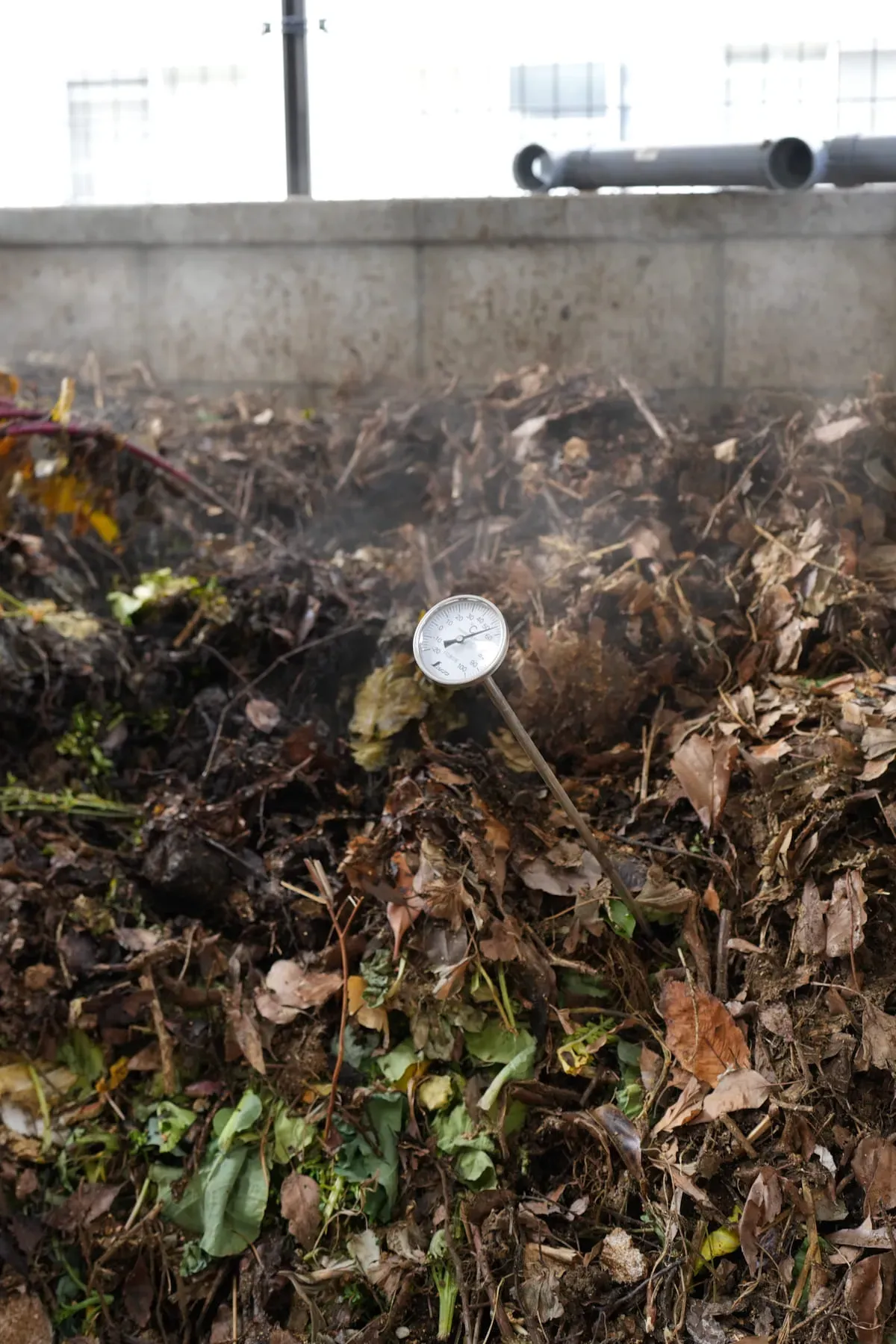
What you see right now is a thermometer stuck in the compost, and the outside temperature today is probably less than 10 degrees, around 5 degrees. It's 5 degrees outside, but the thermometer stuck in the compost is at 60 degrees, so it's fermenting. This area has a history dating back to the Edo period, when people collected food waste around this time of year to make compost, and used the heat generated by the fermentation to accelerate the growth of spring vegetables. Since we are also in charge of a public field, we wanted to learn from this history and make compost in a similar way, so that's what we're doing.
Mayu: You just mentioned the term "spent mushroom substrate," but have you ever been able to collect spent mushroom substrate from anywhere other than ours in this area before? I was also hoping to hear about some of the difficulties you face in composting in this city today.
Hayashi: I've never heard of spent mushroom substrate. But even within the same ward, there are quite a few other food-related waste products besides spent mushroom substrate. Of course, there's coffee grounds from coffee shops and cafes, but also, at another farm that our company manages on Yumenoshima, we get vinegar residue from a vinegar factory. That's mainly rice, and it's like the residue left after further fermentation of sake lees. We've been using that kind of thing for a while, so we were looking for something to mix in when fermenting it.
Mayu: I imagine a lot of different things come together here, but are there any tips or tricks for blending them? Or do I just have to try things out and see what works and what doesn't, or adjust the amount of water, and things like that?
Hayashi: Including myself, all the staff here were complete novices when it came to compost, so we were introduced to someone in Shibuya who had been doing composting for a long time and started an NPO last year. We received guidance from them.
So, we mixed it together while she told us roughly what the ratio should be. At first, we added wood chips from the sawmill in Shin-Kiba, and she told us that this much water would be good. It probably varies depending on the season too.
Here, the hardness of the vegetable waste that comes out differs depending on whether it's the time of year when summer vegetables like cucumbers, tomatoes, and eggplants are available, or the time of year when winter vegetables like okra and shiso leaves are available. The moisture content is also completely different. In the summer, there's a lot of waste that dissolves quickly, but in the winter, there's a lot of waste that retains its original shape for a long time. Depending on the season, it might be better to add spent mushroom substrate, or in the summer, if you don't increase the amount of wood chips, it quickly becomes infested with insects and starts to smell. So, I adjust things as an amateur while observing the state of the compost.
Mayu: Right here where we're standing, there's absolutely no rotten smell at all. It's more like the smell of soil dug up in the mountains. Is this smell one of the ways to check that the fermentation is progressing well and the composting is going smoothly?
Hayashi: That's right. In the summer, as I mentioned earlier, it's prone to spoilage, so if you dig around to let in some air, sometimes a strong ammonia smell comes out. You can release that gas by turning it over, but there are houses and people living nearby in the city. So, we are careful to avoid that smell and a massive insect infestation.
However, insects are also partners that help decompose vegetable waste, so that's where the difficulty lies. If there are too many gnats, it becomes a problem, but with the others, I see them as helping me and growing together with me.
Our main business is landscaping, so ideally, we'd prefer not to have mushrooms or insects around. On the other hand, sometimes we have to prune trees because if mushrooms are growing on them, branches could fall from above and cause injuries. We do preventative pruning work like that.
In the past, we used to incinerate all of that to prevent it from spreading, but recently we've been bringing it in and mixing it in here. We also have something called a bionest, which we've set up over there. We make something like a bird's nest out of branches that have some bacteria in them or have been gnawed on by insects, and we put fallen leaves inside. We let the bacteria transfer from the branches.
I've also started to enjoy decomposing fallen leaves, the kind I used to just throw into garbage bags, and I'm grateful that I've come to feel like I'm getting help from things I previously considered a nuisance in my business, but now as partners.
Mayu: That's really interesting. I think you're putting into practice the natural cycle into our lives. You mentioned earlier that bringing air in is important, so could I ask you a little about that pipe, that original mechanism, that you showed me when I delivered the spent mushroom substrate here last time? What efforts are you making to promote its decomposition?
Hayashi: This place isn't very big right now, so while larger farms can probably use machines to turn the compost over, we can't do that here, so we mostly turn it over by hand to allow for air exchange. To reduce the amount of work involved, we've installed pipes so that air can enter automatically. If air doesn't get in, the fermentation will stop.
That's what I wanted to do, but honestly, I haven't been able to get good results yet. It's quite difficult. I tried laying down shipping pallets to allow air to get in from below, so that air could circulate from there as well, but honestly, I'm not sure yet whether it's having any effect.
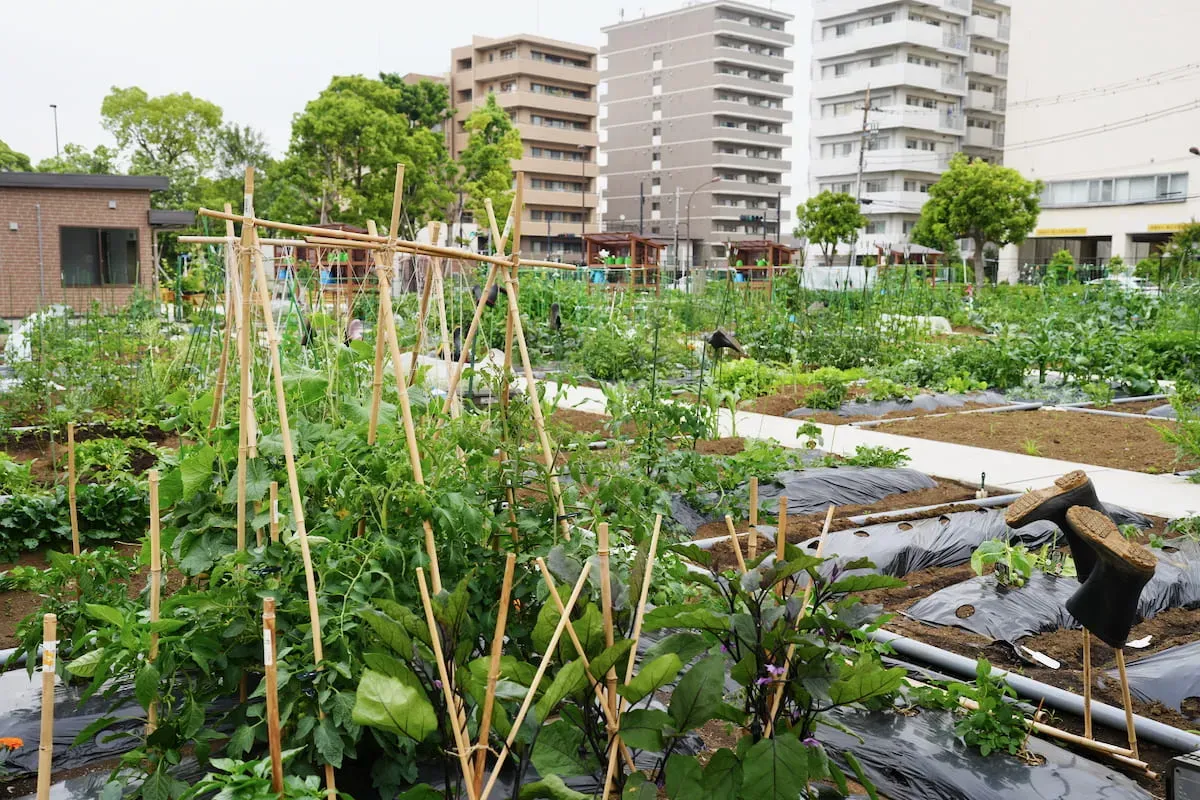
Mayu: I was at the compost area a moment ago, but I've now been moved inside the office. I walked through the farm on my way here, and this community garden is several times bigger than what I imagined a community garden to be. How many plots are there?
Hayashi: Here, we have 151 individual beds, each 10 square meters, and three group beds, each three times the size at 30 square meters. We also have three raised beds that are wheelchair accessible.
Mayu: It's quite rare to see something of this scale in Tokyo.
Hayashi: I wonder. In neighboring Edogawa Ward, there are many farms, so they've converted land that's no longer in use into community gardens. There are a lot of them, but they're not concentrated in one area; they're scattered all over the place. In Koto Ward, including this area, many of the plots are converted or renovated from what were originally some other ward facility, so they're pretty much all clustered together.
Mayu: I was impressed that they were doing it on this scale. When did it start?
Hayashi: The Sunamachi Community Farm was established last April. Before that, this was a fishing pond.
Mayu: So that's why it's this spacious.
Hayashi: That's right. Joto Farm, which is very close by, was originally a swimming pool for the ward.
Mayu: Is converting land to farmland like that becoming a growing trend these days?
Hayashi: I wonder. Yumenoshima was built in 2012, and Sunamachi was built in 2025, so there's a 13-year gap. Even before Sunamachi was built, in order of age within Koto Ward, there was Tatsumi Farm, Joto Farm, Yumenoshima Farm, and now Sunamachi Farm. There are four in total.
Roughly speaking, the odds of getting a plot at Tatsumi Farm are about 2:1, Yumenoshima about 3:1, and Joto about 6:1. For roughly the last 10 years or so, the odds of getting a plot have been like that, so they're incredibly popular. I think Sunamachi was also increased because there was a similar need among the residents, but even if they increase the number of plots, it might still be difficult to rent one easily, which shows just how strong the demand is for these kinds of places among people living in the city.
Mayu: I was hoping to hear what you think and feel after actually trying it out, Hayashi-san.
Hayashi: In terms of my own work, or rather, for our company as a whole, a significant percentage of our work is on public works projects for Koto Ward and the Tokyo Metropolitan Government. I myself originally worked as a site supervisor, building parks and renovating existing parks.
Once it's finished, the barricades are gone, and the moment the handover inspection is over, kids come rushing in and playing on the new playground equipment. When I go to see it a while after it's been open, it's already become a facility that blends into the community. Now that I'm a father, I take my own children to places like that. I didn't do that when I was younger, but now that I'm a father, I take them to places like that. I'm really happy when my work helps create new spots in the community or revitalizes the area.
So, regarding this community garden, I think that by our company operating it, the local cycle will be able to function in various ways, and that people who want to be a part of that cycle, or people who have something but don't know how to use it, or people who want something but don't know what to do with it, can we be there to reach out to them, even if we can't guarantee we'll be helpful, and I think that would be a really good thing.
I believe that ultimately, both for the company and for our own company, there are aspects of that that will contribute to our results, so I try to work with that kind of attitude. After all, if it's not interesting, I'll end up hating my job.
Lots of people, including this time, reached out to us and brought us all sorts of ideas. The group that always runs the Sumida River Marche said they were going to do a bonfire event, so they came to Yumenoshima Farm. We were using some trees that had fallen down in typhoons or something from a property we manage nearby as firewood for our bonfire event, but we had made too much and had quite a bit left over, so we let them take some of that too.
It's a cycle like this: if I say, "We need something like this," someone will say, "Oh, we have some extra here." If I say, "I want to invite this kind of person to this kind of event," someone will say, "Oh, I can introduce you." If I talk about something I want to share with someone, someone will give me an idea for a project by saying, "I produced an event like this the other day." I really love how we all grow together through this process.
So, receiving spent mushroom substrate from SOCIAL CLUB is incredibly welcome, and rather than it being something we need, it's more like we're just using what's already been given to us, and we're always grateful to receive it.
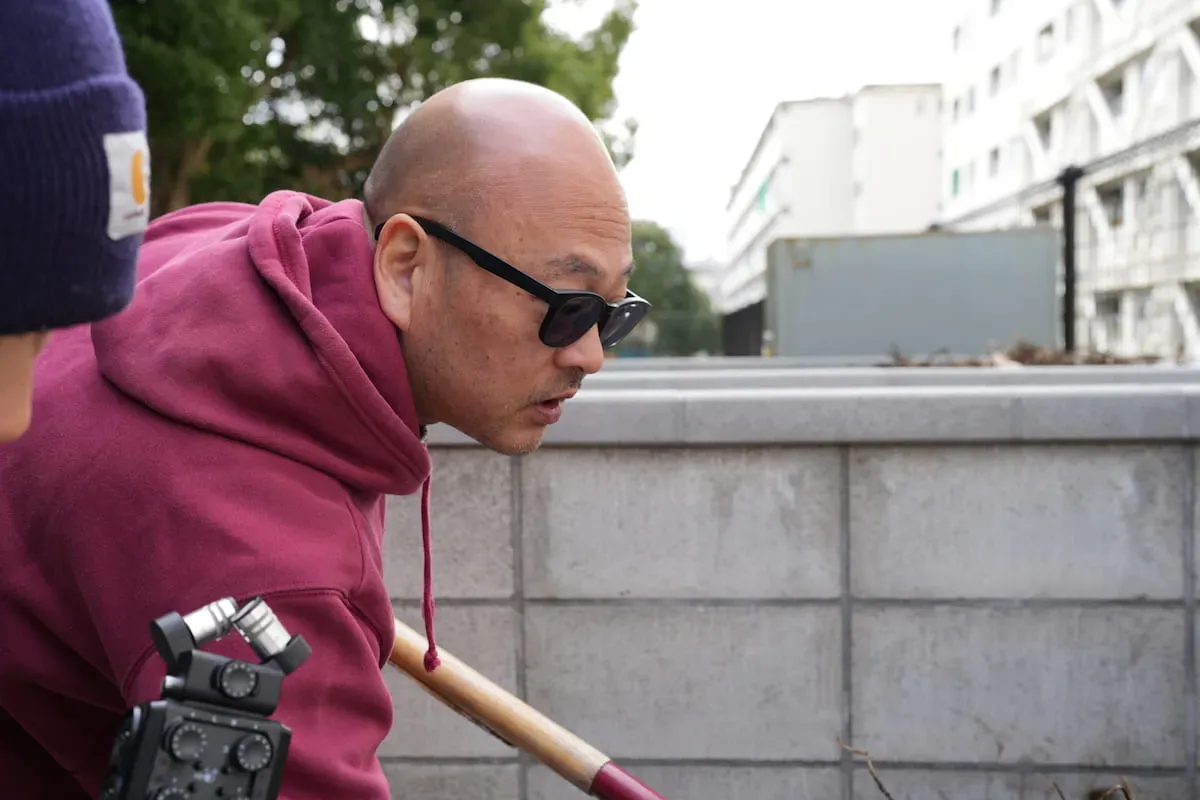
Hayashi: I don't know if this is related, but my hobby is written on the clothes I'm wearing right now, can you read it? You can't, right? It's written in Russian, and it says "Systema Osaka." There's a Russian martial art called Systema that comedians use to say they don't feel pain when they get hit. It doesn't have techniques or forms. It's not like karate or aikido, it's more about using movements that come from within yourself, and fighting in a way that doesn't hurt your opponent too much.
It's the same with my work. I'm not good at creating fixed templates or manuals. Of course, some people succeed with them, but I personally am not very good at them, I'm not good at memorizing things, and I'm not very good at making decisions. So I just adapt to what I'm given—whether it's inspiration, objects, or information. It might seem passive, but I think that's my concept. Probably.
Another characteristic is that there are no matches. Because there are no matches, there's no need to have a secret technique that you absolutely won't show to anyone, so there's a culture of sharing. When someone goes to a seminar somewhere, they come back and make that person the teacher for the day, and they do a sharing class, with everyone thinking that if someone gets better, they can get better too. They tell each other, "I went to this seminar, and this is what I learned." It might not be reproducible, but this is what they learned. I didn't understand it myself, but by sharing it, my teammates might say, "Oh, doesn't that mean this?" and then there's the possibility of getting feedback and thinking, "Oh, I see." They've been doing these kinds of sharing classes and have been comfortable with the lack of a set format for a long time.
Perhaps in our work, we don't keep things as company secrets. We tell everyone that we make compost here, and we're completely open about what we mix in it. If that helps spread composting to other regions, we'd be very grateful. If people try it there and tell us things they didn't notice here, it will help us improve as well. I think that's the kind of work style we probably have.
Mayu: After hearing your story, I realized that while the KINOKO SOCIAL CLUB has many themes, one of them is open resources or open source. We don't keep things to ourselves, but open them up, share them, and teach each other, which is something we really value, so I felt that we have a lot in common there. If I hadn't heard this, I wouldn't have known, so I realized that we actually share the same feelings and that we've connected through this spent mushroom substrate.
Hayashi: That might be true. There are limits to what an individual can own, and on the other hand, we live in an age where you can order anything on Amazon and get it the next day. But I think it's not about consumption, but about sharing, I guess. Sharing is spreading more and more, both for information and goods. I want to make society better, and if society improves, then I think our company's performance will improve, and ultimately my salary will go up, and my family will be happy too. I want to create a good cycle.
Mayu: Everything is really interconnected, and if there isn't that horizontal connection, the problem might not seem that big, but if you try to solve it alone, it can seem really big. That's why I think it's really interesting to see how we can distribute and share information to tackle challenges. We also want to be part of that cycle, collecting coffee grounds, growing mushrooms from them, and then having them used for compost. Right now, spent mushroom substrate is one of our main activities, but in the future, we hope to expand that cycle to other fields, not just food, but also ways of thinking and information.
Mayu: Listening to what you've said, even though it's not directly related to the KINOKO SOCIAL CLUB, street trees are always being pruned, right? Of course, as I mentioned earlier, there are many reasons for pruning, such as preventing mushrooms from growing on them or insects from infesting them and causing them to get diseased and die. But I've always thought that Tokyo has a huge number of street trees, and it would be interesting to prune the less usable varieties and then plant mushroom spores in them and cultivate them on logs.
Hayashi: To explain the current situation, every detail of a construction project is predetermined. Not only is the number of trees to be cut fixed, but the waste generated after cutting is also collected by licensed contractors. There are general waste and industrial waste. We can cut and load the waste, but the transportation is done by licensed contractors. The destination, or disposal site, must also be a licensed location. For example, wood can be taken to a waste incineration plant as general waste. For construction projects, concrete, for instance, must be taken as industrial waste. With industrial waste, the person generating the waste, the person transporting it, and the person processing it must all sign a contract beforehand. Even with general waste, there's a manifest, and everyone has to sign a document detailing what was generated and received at which site on what date, and this document must be kept for five years.
That's also decided. Otherwise, there would probably be illegal dumping, so we do it to prevent that. Here too, if there are no regulations on the amount of waste at other sites, we can reuse it. But if a company like ours receives money that includes disposal costs from the beginning, and we say we're not disposing of it but growing mushrooms, then they'll say, "Oh, the disposal costs we gave you were for burning it at the factory," so this is also quite complicated. When we made BioNest, we also got asked, "Where did you get this wood from?" We had to explain it properly.
So, that framework is currently in place to prevent bad practices, which is very important, but I personally would like to find more flexible ways to use the generated materials, or rather, to reuse them. I once had a really thick log that had fallen, and I had someone who was good at using a chainsaw cut it horizontally, and then we attached legs with metal clamps to make a bench. I would really like to do more of that kind of thing.
Mayu: If we're going to burn it anyway, wouldn't it be interesting to take some time to decompose it, make some food out of it, and then return it to the earth?
Hayashi: That's right. It's such a waste to burn everything, and if possible, I think there are many other uses for it, like turning it into wood chips or firewood. It must be a lot of work, I'm sure.
Mayu: But in order to run things at the city or country level, those rules are incredibly important, aren't they?
Hayashi: I think it would be a good idea to start with an experimental approach at the municipal level. For example, when constructing parks, there are always trees that have to be cut down, so if we limit it to within the park, we could make them reusable. The disposal costs saved could then be used for something else, like increasing the amount of flowers planted, so hopefully, we can gradually increase the number of such examples.
Even with park construction, there are of course branches and trees that we don't necessarily want to cut, but from an outsider's perspective, it can look like the construction workers are cutting down important trees, and people nearby get angry when they see the trees being cut.
Mayu: I think there's a generally very negative image associated with cutting down trees. But of course, there are times when it's better to cut down trees, and I think there are various reasons for that.
Hayashi: If it's a tree in the mountains, or like the trees at Meiji Jingu Shrine, there's the issue of the outer garden, and I agree that the trees in the inner garden of Meiji Jingu Shrine should not be cut down. But trees in the city, like those in the outer garden, have a completely different reason for existing. Trees standing in the middle of asphalt need to be maintained, and trees that exist as part of a forest should be left as they are. It's not a matter of right or wrong, but rather about putting the right tree in the right place.
However, instead of simply burning the cut-down trees, we should try to find a second life for them, or a way to use them. For example, they could become compost or wood chips that can be used to pave the ground where children play. If we can give them a new purpose right there, it would make us construction workers even happier.
Mayu: It would be interesting to see those kinds of changes in the future.
Hayashi: That's right.
Mayu: But it all starts with thinking about things like this, doesn't it? I think the things you do and the state of the compost change depending on the season, so I'd love to hear from you again at a different time. I hope that we can continue to exchange information and maintain these connections, as I mentioned earlier, so I look forward to working with you in the future. Thank you so much for taking the time out of your busy schedule today.
Hayashi: Not at all. Thank you for coming.
Mayu: Thank you very much.
NAKAJIMA Kimi
Freelance, living in Ryukazaki, Ibaraki. I first encountered Monosus through an interview with “Nihon Shigoto Hyakka” and am now involved in several things, a bit outside of Monosus.