
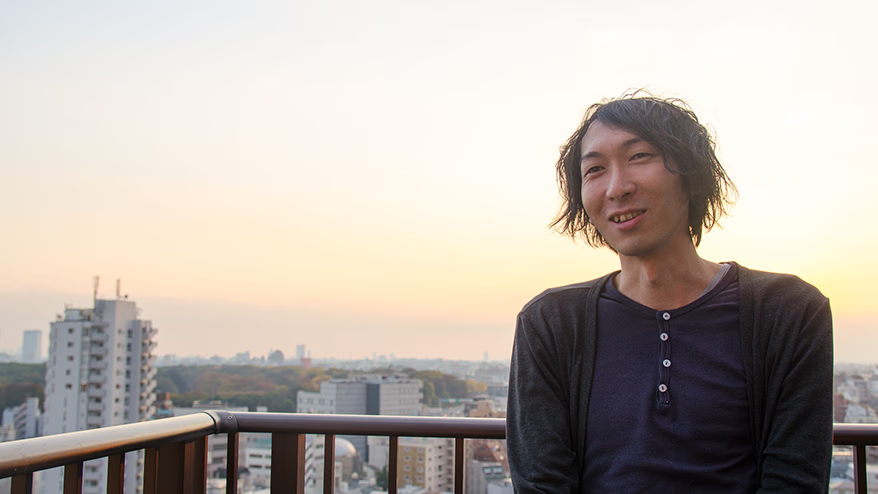
I believe it was around the summer of 2013 that Mr. Nagakura from Pilot Corporation contacted Coding Factory.
After that, we continued to receive project requests from them a few times a year, and they even came to Monosus's parties, but...
This year, I received an email from Mr. Nagakura saying, "I'd like to create a network of people from companies with offices in Yoyogi that can serve as a foundation for exchanging ideas and fostering collaboration." And so, he organized the "Yoyogi Web Production Gathering." Although I work in sales, I've always felt that it would be great to have a gathering where creators can openly exchange information, so I sympathized with Mr. Nagakura for putting that idea into practice. I would love to collaborate with him on something in the future, like a friendly neighborhood relationship.(Monosus Okuyama Hideno)
Because we are in the "IT industry," we seek close communication.
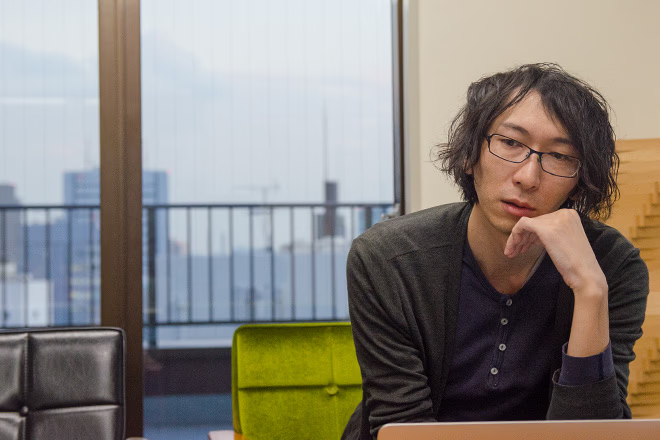
About 10 years ago, I joined the web production company "Pilot" as a mid-career hire. The company had only been established for about two years at the time, and there were only about 10 members. Originally, I had worked for a large IT company, where each department had its own specialists, and we rarely had the opportunity to talk directly with clients. It was unavoidable, but I wanted to proceed with even the smallest project after understanding the client as much as possible. However, I was so preoccupied with producing only a limited part of the project that I couldn't even see the bigger picture, let alone think, "I want to do it this way!" I had a vague sense of unease about that, so I decided to change jobs to a company where I could communicate more with clients.
Now, we get direct feedback from customers, and we're also closer to our staff within the company. I think it's great to be able to talk to people immediately if something comes up. Even if the scale of the projects is smaller, I think it's more interesting to be able to work closely with customers.
I will share my experiences as I unravel the mysteries of the unknown world I have stepped into.
I was born in Sendai City, Miyagi Prefecture, and lived there until I went to university. I was in the Faculty of Letters, but it was right in the middle of the job-hunting ice age. I'm not very good at talking to different people or selling things, so I thought I couldn't do a sales job... (laughs).
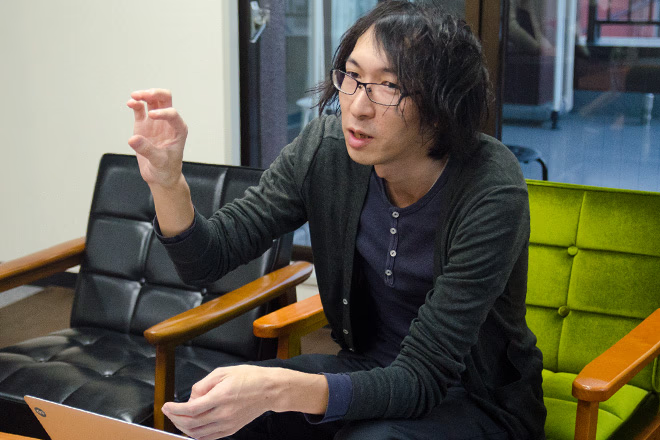
My major, cultural anthropology, is a field of study that involves venturing into completely unfamiliar worlds and unraveling how they work, and I did a lot of fieldwork. I wasn't very familiar with IT, but at the time, the number of SE (Systems Engineer) jobs was increasing, and it was the heyday of implementing core business systems. Even though it was called a system, much of the work involved transcribing the user's business requirements into written form and communicating them. Thinking about it, it might be a stretch, but I think that going into completely unfamiliar clients and industries, conducting interviews, and then creating diagrams and writing down the information is connected to what I learned in university.
The opportunity to rethink urban life comes from exploring different ways of working and living in rural areas.
One of our executives originally worked at a shared office in Osaka. A designer he worked with there happened to have a satellite office in Green Valley , Kamiyama Town. He invited me to Kamiyama, saying it was interesting, and that's how I ended up going there with him in March of this year. At first, I wondered why we'd go to such a rural area, but once I got there, I thought, "Ah, I see!" (laughs). Companies that didn't know each other at all were gathered together, working during the day and drinking together at night. I thought that scene was really interesting. On the way back, we stopped by a shared kitchen in Wakayama City. People from companies in the city were using the cafe space to hold seminars and events.
Visiting Kamiyama and Wakayama at the same time made me realize, "The countryside is fascinating!" I've lived in Tokyo for 10 years, but I've never encountered a community like that. There are an enormous number of companies around, so I started to feel a sense of unease about why they only exist as isolated points.
My hometown of Sendai is also a regional city, and I've lived in Tokyo ever since, so when I first went to Kamiyama, I was deeply moved, thinking, "There's a way of life like this?" It's amazing how people can make a living and work within this region. The environment is very rural, with large old farmhouses. It's the kind of scene you'd just drive past, but once you step inside, you see rows and rows of PCs and servers, and everyone is working there. That had a huge impact on me. It's a place where it seems like there are only grandparents, but every night young people from various companies gather there drinking. The environment where you can get to the office in a minute's walk from your home is also great, and I imagine the stress levels are completely different. I'm sure there are various difficulties if you actually live there, though.
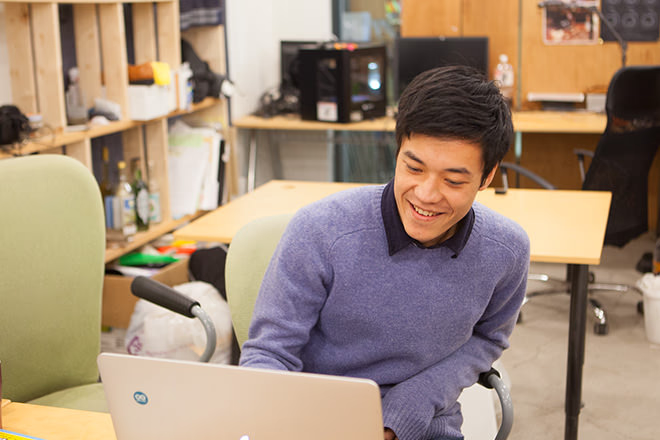
Yamashita, a pilot, works at a satellite office located in the Kamiyama complex.
We established a satellite office in Kamiyama partly because we were invited by Green Valley, but a major reason was that after actually visiting Kamiyama, we felt a strong desire to create a way of working in a place like this that wouldn't be possible in Tokyo.
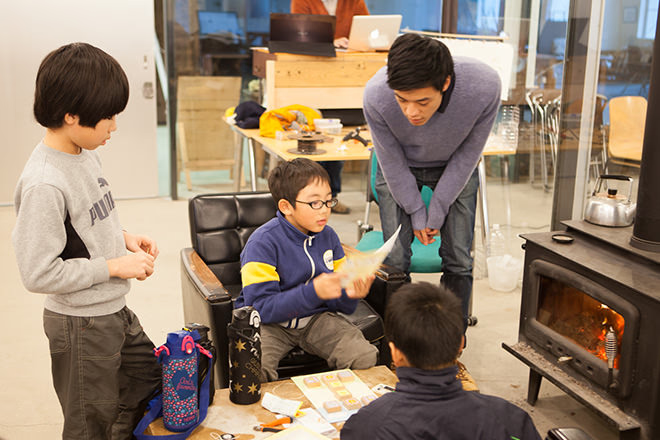
Yamashita-san, who works at a satellite office in Kamiyama, teaches electronics to elementary school students. Once a week, she and other people in the same shared office run a children's electronics workshop.
"Yoyomoku" starts by building connections with your neighbors.
Since I was on the inside and not in sales, it was difficult to connect with people outside the company. Aside from the initial meeting, we often communicated via email without meeting in person. At this rate, it would be impossible to build a community. Even if I went to seminars and events and exchanged business cards, it rarely led to a deeper relationship. Also, there are a lot of things I want to discuss before work starts. But it's hard to ask questions if you don't have a relationship with the person, so I thought it would be good to have a "neighborly" kind of atmosphere. That's why I started "Yoyomo," where we open our office as a co-working space every Thursday, as a place where people who work in this area can gather.
When I eat lunch around here and look at the table next to me, I often think, "They seem to be in the same industry," but I never have a chance to meet them. However, when I reached out to the surrounding companies through "Yoyomok," several people came. Now, when we see each other in the neighborhood, we say hello and have a quick chat. I feel like we're gradually becoming neighbors. It's interesting to see how business opportunities are arising and connections are being formed between companies that have come to "Yoyomok."
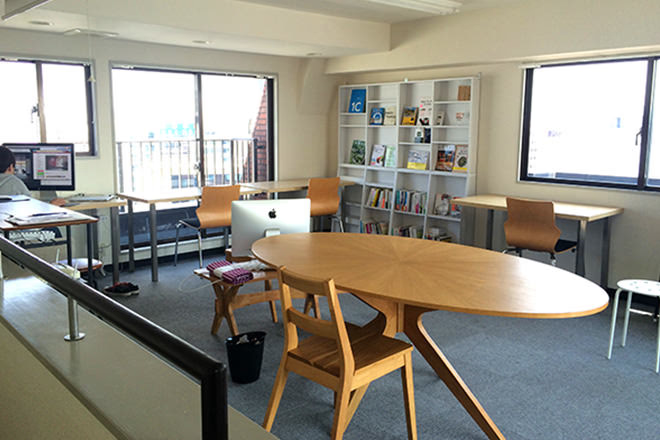
Yoyomoku's co-working space, which is part of their office.
For the past 10 years, I've been commuting every morning on a train I absolutely hate (laughs), and I often wonder what the point of coming to work is. But recently, when I walk to the office in the mornings like this, I find myself greeting and talking to people I've met at "Yoyomoku," and as that kind of communication gradually increases, I sometimes feel like I do have a place here. If I can create a community like that, within my means, then maybe there is a point to coming to work after all (laughs). Sometimes we might be wary of people in the same industry and think of them as "competitors!", but when you talk to them, you often find that they're working in different fields. Being able to complement each other might be important for small and medium-sized enterprises.
Building mutual trust through direct relationships
I knew about Monosus's "Coding Factory Division" even before Pilot had a location in Yoyogi. We have coding staff within our company, but at the time, the quality and standards were all over the place, and we were trying to improve things somehow. That's when I attended a coding seminar that Monosus was holding. Because of that, we asked Monosus to cooperate with us on a large-scale website development project.
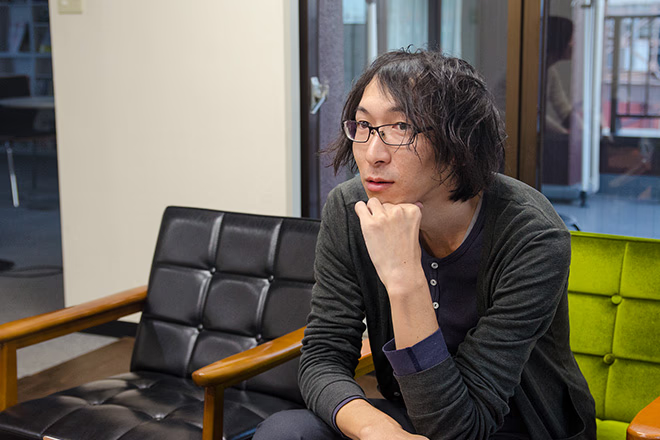
At first, I had the impression that he was like a very precise and rigid machine. I even wondered if Mr. Okuyama might be a scary person (laughs). But as we worked together, he was very helpful and flexible, and he gave me advice on various things. With large-scale projects, the situation changes in detail, but he was flexible in that regard as well. As we continued to work together, my impression of him softened (laughs). Instead of just going through the motions, he would ask questions about each and every thing I was unsure of, and he would respond carefully. I received not only contact from the person in charge, but also directly from the person actually doing the coding. After all, he's close by (laughs). Especially in these times, it's very reassuring to be able to work face-to-face as much as possible. I think it's quite a miraculous coincidence that we both have bases in Yoyogi and connections in Kamiyama-cho (laughs). When we started the "Yoyogi Web Production Gathering," there was talk from within the company right away of "Let's involve Monosus."
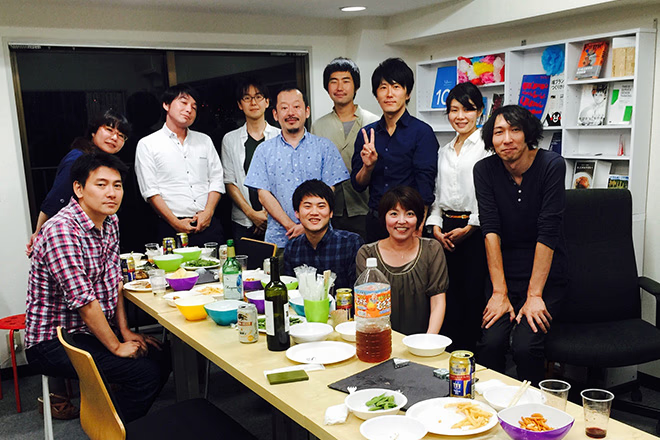
Group photo from the first Yoyogi Web Production Meeting
I'm really feeling like our network is expanding through "Yoyomoku" and "Yoriai." I want to create opportunities for fellow professionals in the same field to meet and have casual conversations. To do that, I think I need to broaden my own perspective even more. I'm always a little nervous because I'm probably the worst at socializing. So, I'd really appreciate Monosus's continued cooperation... I'm sure that's Mr. Okuyama's area of expertise, right? (laughs)
Shintaro Nagakura's Profile

Monosus Site Team
How to create good blood circulation with members and other people involved? How can we deepen our relationships to do better work? While thinking about this, we introduce the people and work of Monosus. The secretariat has approximately five members. I love eating a lot.